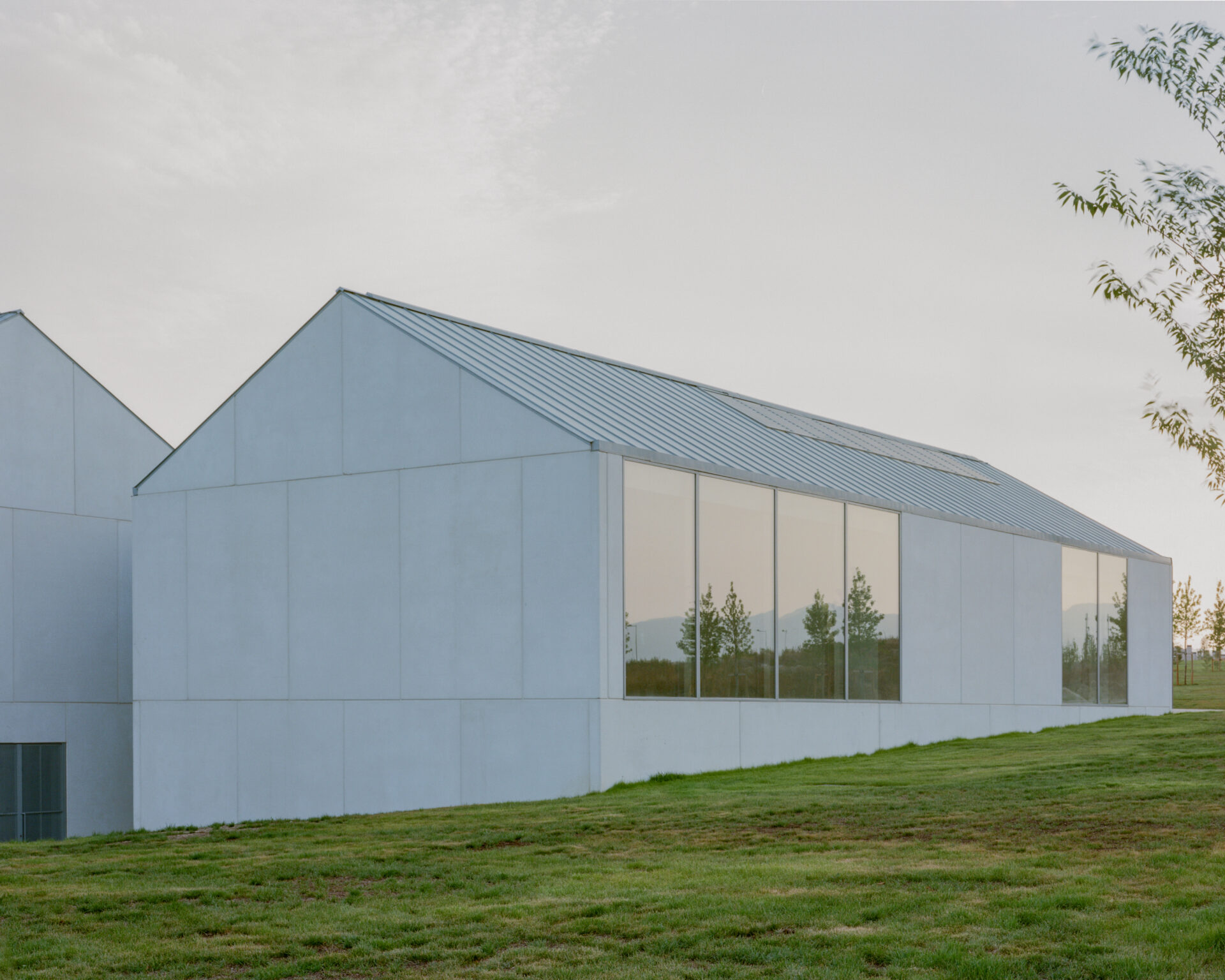
The new Tres Cantos Civic and Family Centre proposes an open, community-oriented architecture that is closely integrated with the landscape of the Parque del Paraninfo. Inspired by Françoise Dolto’s La Maison Verte model, the project views childhood and care as fundamental elements of urban life. Four volumes with gabled roofs are arranged around a central courtyard opening onto the park, reinterpreting the logic of vernacular architecture. Classrooms, an auditorium and a café are linked by an internal cloister that transforms the circulation spaces into areas for meeting, playing and sharing.
The new Tres Cantos Civic and Family Centre proposes an open, community-oriented architecture that is closely integrated with the landscape of the Parque del Paraninfo. Inspired by Françoise Dolto’s La Maison Verte model, the project views childhood and care as fundamental elements of urban life. Four volumes with gabled roofs are arranged around a central courtyard opening onto the park, reinterpreting the logic of vernacular architecture. Classrooms, an auditorium and a café are linked by an internal cloister that transforms the circulation spaces into areas for meeting, playing and sharing.
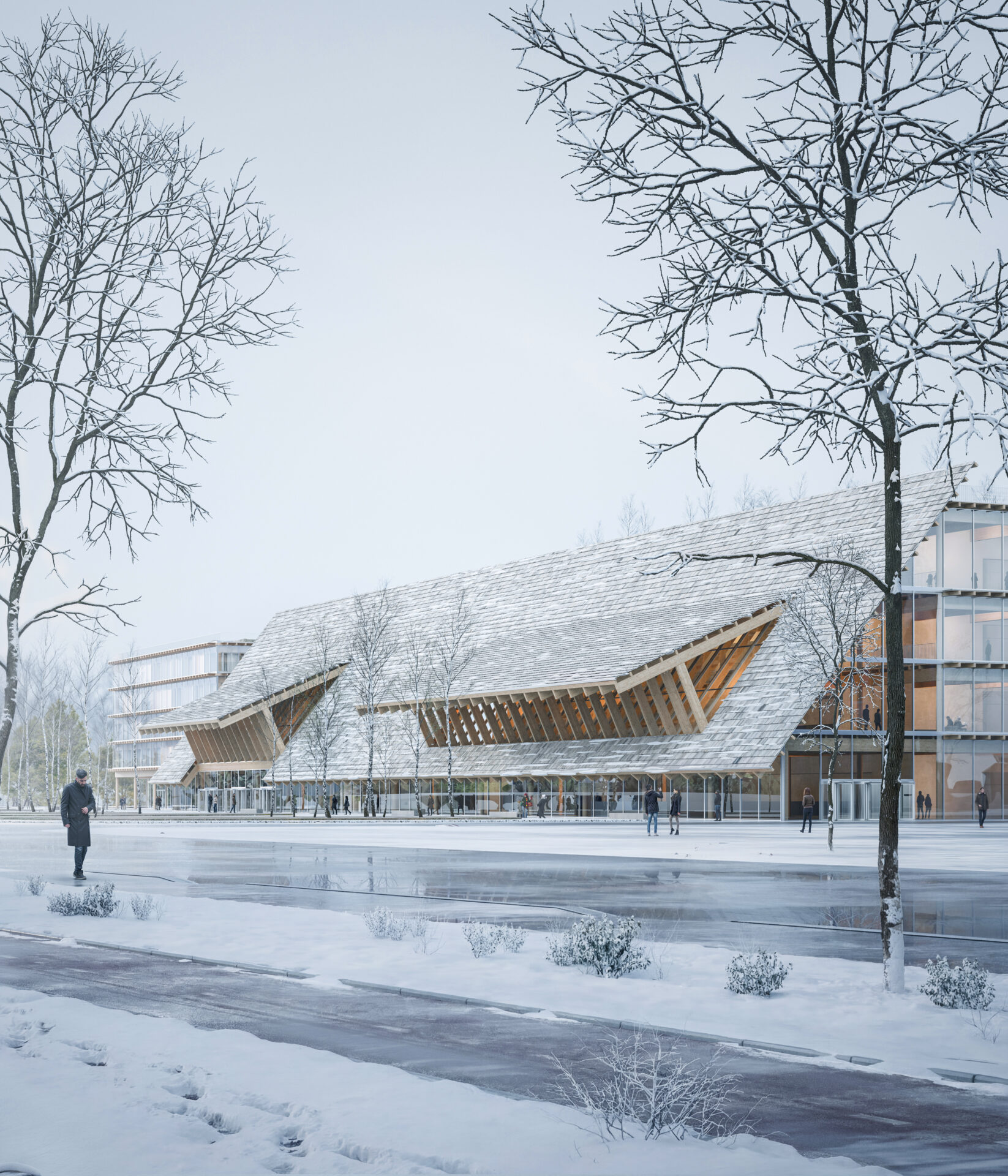
The Vilnius Congress Centre reimagines the humble barn—klojimo teatras—as a contemporary civic instrument: an architecture of gathering that shelters, stages, and sustains public life. Rooted in a history of quiet cultural resistance, the design translates intimate communal practices into a monumental yet welcoming riverfront presence. Three linear auditoria align along a single civic axis, anchored by a continuous multi-height lobby that draws the park inward, blurring interior and exterior with generous glazing, daylight, and greenery. A single-pitched timber roof, evoking vernacular form, unifies the ensemble and frames a sequence of public realms: luminous foyers, terraces, informal meeting zones, and a sculptural spiral stair that rises to a balcony of light and encounter. Behind the scenes, an invisible service spine houses backstage, offices, VIP, and technical functions, keeping public spaces open, flexible, and luminous. At the summit, an elevated roof garden and public restaurant form a civic belvedere with panoramic views across river and city, transforming the rooftop into an accessible horizon for everyday life and special events.
The proposal forges a civic continuum: a coherent complex including a 120-key hotel, pedestrianized approaches, a waterborne pontoon, and shared streets that knit the city to the river. Auditoria deliver adaptable, high-quality acoustic environments; modular partitions, independent systems, and dedicated service access enable simultaneous events with operational clarity.
Sustainability is integral: cross-laminated timber reduces embodied carbon and accelerates delivery; passive strategies limit energy demand; photovoltaic arrays, geothermal systems, and river-integrated heating and cooling support resilient, low-carbon performance. The result is a congress centre that is simultaneously stage, shelter, and social condenser—an inviting civic landscape where culture, dialogue, and the life of the city converge.
The Vilnius Congress Centre reimagines the humble barn—klojimo teatras—as a contemporary civic instrument: an architecture of gathering that shelters, stages, and sustains public life. Rooted in a history of quiet cultural resistance, the design translates intimate communal practices into a monumental yet welcoming riverfront presence. Three linear auditoria align along a single civic axis, anchored by a continuous multi-height lobby that draws the park inward, blurring interior and exterior with generous glazing, daylight, and greenery. A single-pitched timber roof, evoking vernacular form, unifies the ensemble and frames a sequence of public realms: luminous foyers, terraces, informal meeting zones, and a sculptural spiral stair that rises to a balcony of light and encounter. Behind the scenes, an invisible service spine houses backstage, offices, VIP, and technical functions, keeping public spaces open, flexible, and luminous. At the summit, an elevated roof garden and public restaurant form a civic belvedere with panoramic views across river and city, transforming the rooftop into an accessible horizon for everyday life and special events.
The proposal forges a civic continuum: a coherent complex including a 120-key hotel, pedestrianized approaches, a waterborne pontoon, and shared streets that knit the city to the river. Auditoria deliver adaptable, high-quality acoustic environments; modular partitions, independent systems, and dedicated service access enable simultaneous events with operational clarity.
Sustainability is integral: cross-laminated timber reduces embodied carbon and accelerates delivery; passive strategies limit energy demand; photovoltaic arrays, geothermal systems, and river-integrated heating and cooling support resilient, low-carbon performance. The result is a congress centre that is simultaneously stage, shelter, and social condenser—an inviting civic landscape where culture, dialogue, and the life of the city converge.
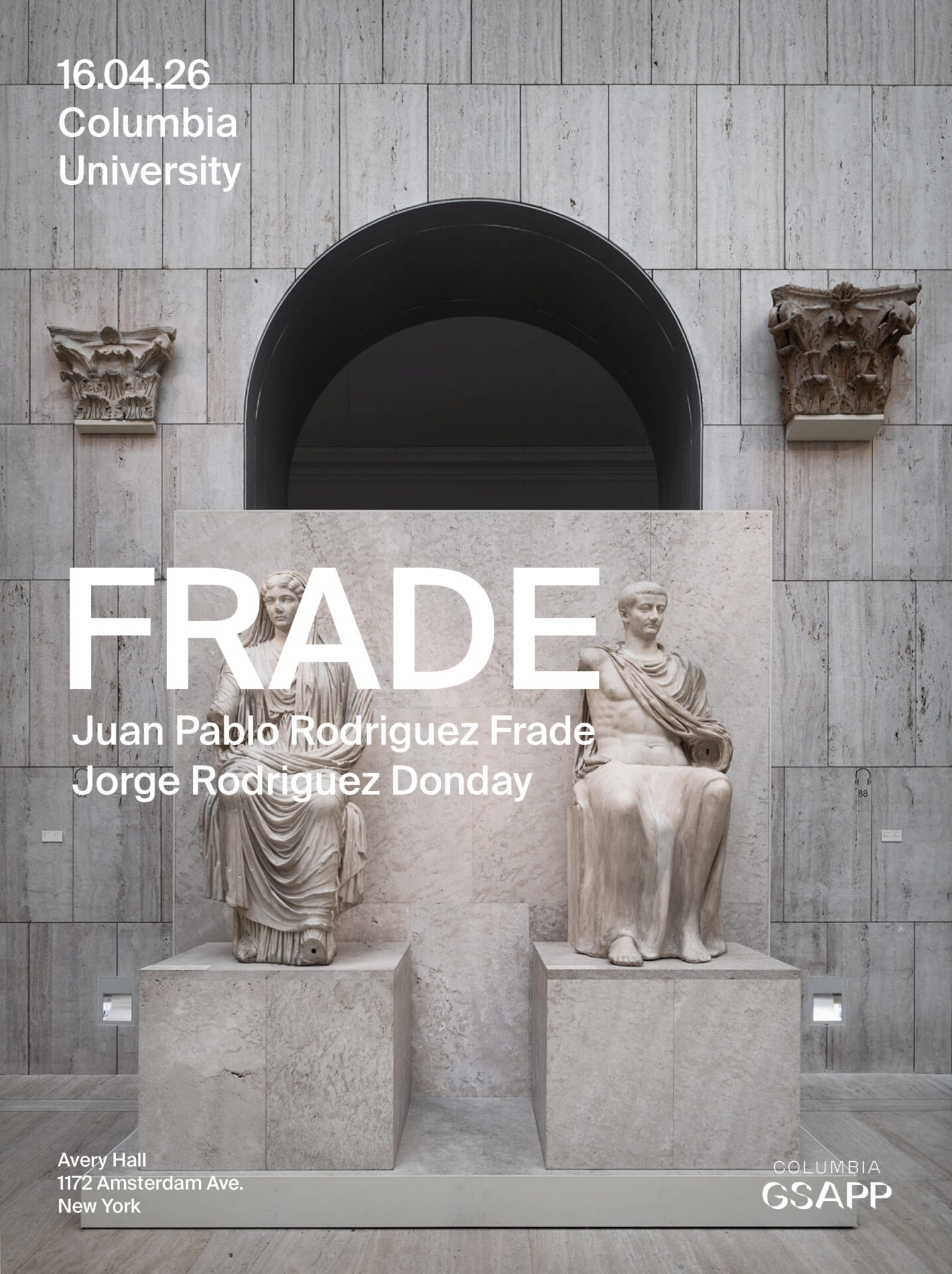
Join us on April 16th for our upcoming lecture in the Preservation Lecture Series by Juan Pablo R. Frade and Jorge Rodriguez Donday (Frade Arquitectos). The lecture will be followed by a response and Q&A by Jorge Otero-Pailos.
The Presentation, “Heritage and Opportunities,” presents the trajectory of Frade Arquitectos and their engagement with architectural heritage as both a professional niche and a source of design innovation. Beginning with exhibition design, the practice developed a sensitivity to space, narrative, and detail that naturally evolved into the renovation of highly protected historic buildings.
Through projects such as the San Isidoro de León complex and the National Archaeological Museum of Spain, the architects highlight how constraints inherent to heritage work foster creative strategies, adaptability, and the discovery of unexpected spatial and historical values, also emphasizing the importance of accessibility, respect for legacy, and collaboration with traditional craftsmanship. Extending these principles to new architecture, Frade demonstrates how heritage analysis can inform contemporary projects, exemplified by the Alicante Congress & Exhibition Centre, where historical references shape both form and performance, creating a dialogue between past and present.
Join us on April 16th for our upcoming lecture in the Preservation Lecture Series by Juan Pablo R. Frade and Jorge Rodriguez Donday (Frade Arquitectos). The lecture will be followed by a response and Q&A by Jorge Otero-Pailos.
The Presentation, “Heritage and Opportunities,” presents the trajectory of Frade Arquitectos and their engagement with architectural heritage as both a professional niche and a source of design innovation. Beginning with exhibition design, the practice developed a sensitivity to space, narrative, and detail that naturally evolved into the renovation of highly protected historic buildings.
Through projects such as the San Isidoro de León complex and the National Archaeological Museum of Spain, the architects highlight how constraints inherent to heritage work foster creative strategies, adaptability, and the discovery of unexpected spatial and historical values, also emphasizing the importance of accessibility, respect for legacy, and collaboration with traditional craftsmanship. Extending these principles to new architecture, Frade demonstrates how heritage analysis can inform contemporary projects, exemplified by the Alicante Congress & Exhibition Centre, where historical references shape both form and performance, creating a dialogue between past and present.
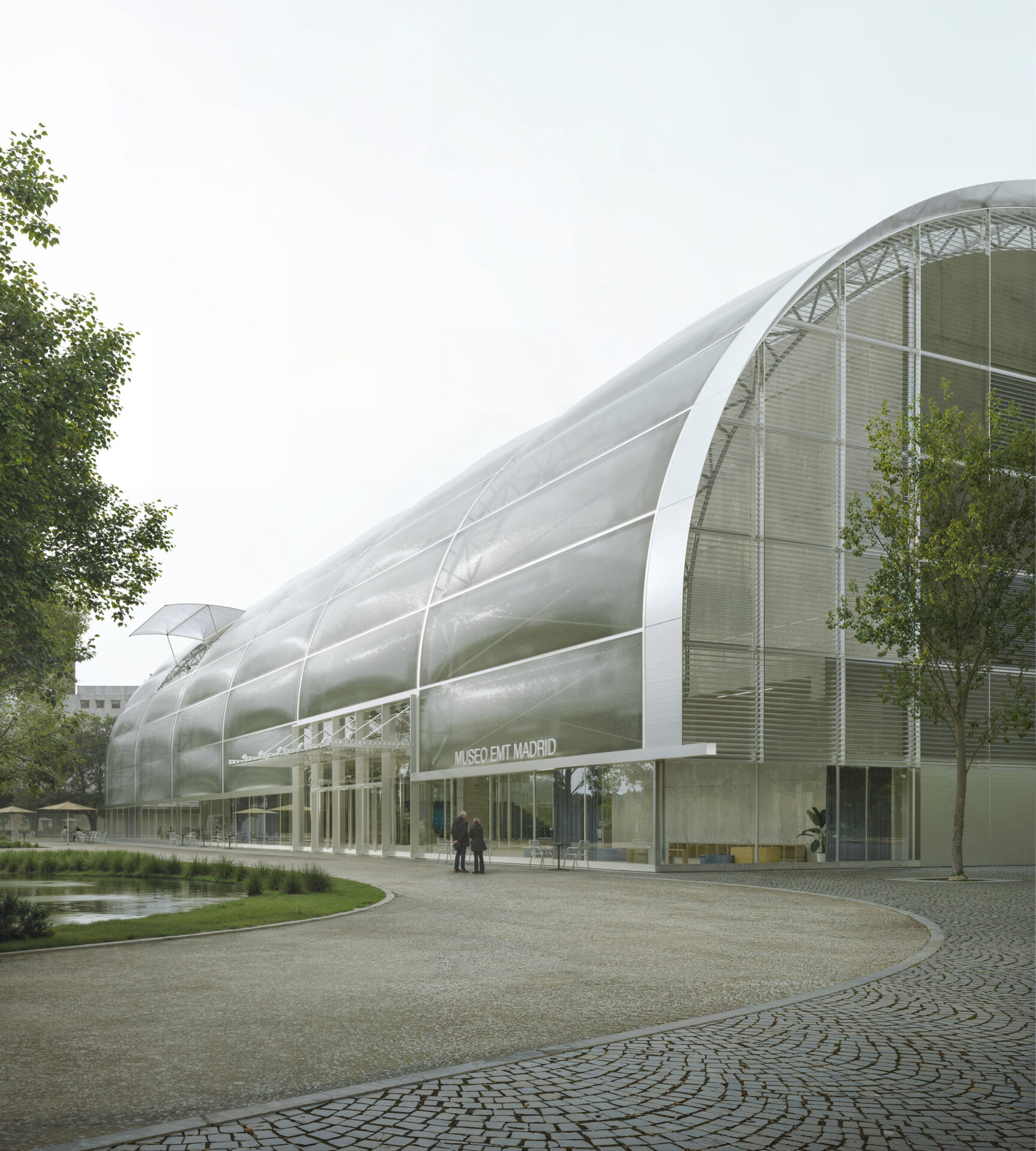
Our proposal emerges as a transformative urban intervention on the former site of the Vicente Calderón Stadium, strategically positioned between the Pirámides neighbourhood and the Manzanares River. Conceived as an extension of the Madrid Río regeneration, the building acts as a hinge between city and landscape, mediating the solidity of the urban fabric and the organic dynamism of nature. Its clear geometry respects existing urban alignments, while a translucent envelope softens its presence, dissolving physical and visual boundaries between inside and outside.
Designed as a new emblem for the EMT, the project reinterprets industrial typologies—such as bus depots and hangars—through a contemporary architectural language that prioritizes sustainability, efficiency, and identity. The museum is envisioned not as a static container, but as a living, evolving institution that reflects the social, technological, and cultural evolution of Madrid’s public transport system. Flexible circulation and clearly separated public and service flows ensure both an engaging visitor experience and efficient internal operation.
Large, column-free exhibition spaces allow the display and movement of historic buses through innovative structural solutions, combining a robust reinforced-concrete bridge system with a lightweight metal and ETFE envelope. The ground floor functions as a highly adaptable platform, capable of hosting exhibitions, workshops, conferences, and public events, reinforcing the museum’s role as a civic and cultural hub.
Environmental commitment is embedded from the outset through a holistic design approach. The ETFE air-cushion facade operates as a passive climatic system, optimizing light, thermal performance, and energy efficiency while remaining recyclable, lightweight, and durable.
Our proposal emerges as a transformative urban intervention on the former site of the Vicente Calderón Stadium, strategically positioned between the Pirámides neighbourhood and the Manzanares River. Conceived as an extension of the Madrid Río regeneration, the building acts as a hinge between city and landscape, mediating the solidity of the urban fabric and the organic dynamism of nature. Its clear geometry respects existing urban alignments, while a translucent envelope softens its presence, dissolving physical and visual boundaries between inside and outside.
Designed as a new emblem for the EMT, the project reinterprets industrial typologies—such as bus depots and hangars—through a contemporary architectural language that prioritizes sustainability, efficiency, and identity. The museum is envisioned not as a static container, but as a living, evolving institution that reflects the social, technological, and cultural evolution of Madrid’s public transport system. Flexible circulation and clearly separated public and service flows ensure both an engaging visitor experience and efficient internal operation.
Large, column-free exhibition spaces allow the display and movement of historic buses through innovative structural solutions, combining a robust reinforced-concrete bridge system with a lightweight metal and ETFE envelope. The ground floor functions as a highly adaptable platform, capable of hosting exhibitions, workshops, conferences, and public events, reinforcing the museum’s role as a civic and cultural hub.
Environmental commitment is embedded from the outset through a holistic design approach. The ETFE air-cushion facade operates as a passive climatic system, optimizing light, thermal performance, and energy efficiency while remaining recyclable, lightweight, and durable.

Espardeyner is conceived as more than a building; it is an act of city-making rooted in memory, climate, and collective life. Positioned between Elche’s historic Vila and the contemporary fabric of Altabix, the project weaves together heritage and innovation, transforming a strategic urban corner into a vibrant civic landmark. Guided by the Mediterranean sun and the rhythms of the palm grove, the architecture responds with clarity and restraint. A compact volume rises from a solid base, opening itself to light, air, and public space. Its vegetal veil—crafted from esparto—recalls ancestral wisdom, filtering sunlight as it once did in vernacular homes, while redefining it through contemporary expression.
At ground level, the project gives the city back to its people. Streets soften, thresholds dissolve, and a new urban agora emerges—shaded, accessible, and alive with social exchange. Inside, spaces unfold intuitively, balancing public experience with operational precision, while performance halls at the heart of the building offer acoustic excellence and immersive encounters. Sustainability here is not an added layer, but a guiding principle: passive climate strategies, local materials, renewable energy, and geothermal systems work together to minimize environmental impact while maximizing comfort.
Espardeyner stands as a dialogue between past and future—a place where tradition becomes innovation, where architecture amplifies community, and where the city finds a new pulse, deeply connected to its landscape, its climate, and its people.
Espardeyner is conceived as more than a building; it is an act of city-making rooted in memory, climate, and collective life. Positioned between Elche’s historic Vila and the contemporary fabric of Altabix, the project weaves together heritage and innovation, transforming a strategic urban corner into a vibrant civic landmark. Guided by the Mediterranean sun and the rhythms of the palm grove, the architecture responds with clarity and restraint. A compact volume rises from a solid base, opening itself to light, air, and public space. Its vegetal veil—crafted from esparto—recalls ancestral wisdom, filtering sunlight as it once did in vernacular homes, while redefining it through contemporary expression.
At ground level, the project gives the city back to its people. Streets soften, thresholds dissolve, and a new urban agora emerges—shaded, accessible, and alive with social exchange. Inside, spaces unfold intuitively, balancing public experience with operational precision, while performance halls at the heart of the building offer acoustic excellence and immersive encounters. Sustainability here is not an added layer, but a guiding principle: passive climate strategies, local materials, renewable energy, and geothermal systems work together to minimize environmental impact while maximizing comfort.
Espardeyner stands as a dialogue between past and future—a place where tradition becomes innovation, where architecture amplifies community, and where the city finds a new pulse, deeply connected to its landscape, its climate, and its people.

.
The Museum of Islamic Art in Fez is located in the heart of this historic city, in the medina known as Fes el Bali. Amidst its narrow, labyrinthine streets stands Dar Batha, a palace built in the mid-19th century as the summer residence of Sultan Hassan I. The single-storey building is organised into two wings flanking a central garden, all protected by a solid perimeter wall.
The project, promoted by the Fondation Nationale des Musées, aimed to adapt this old building into a museum where the collections interact with the existing space through a contemporary language. To achieve this, a serene and timeless museography was chosen, based on local construction techniques, such as stucco, combined with state-of-the-art technology that guarantees the preventive conservation of the pieces, as well as their proper display.
The interior of the museum houses a valuable collection of 6,500 archaeological and historical objects. Many of them come from mosques and madrasas in the city, such as the Mosque of the Andalusians and the Mosque of Al-Qarawiyyīn. Among the most notable pieces are architectural fragments from the Idrisi period and the remains of the 9th-century minbar from the Andalusian Mosque. The collection also includes historical Korans, astrolabes, musical instruments, carpets, jewellery and an extensive display of local ceramics in the characteristic blue style of Fez.
.
The Museum of Islamic Art in Fez is located in the heart of this historic city, in the medina known as Fes el Bali. Amidst its narrow, labyrinthine streets stands Dar Batha, a palace built in the mid-19th century as the summer residence of Sultan Hassan I. The single-storey building is organised into two wings flanking a central garden, all protected by a solid perimeter wall.
The project, promoted by the Fondation Nationale des Musées, aimed to adapt this old building into a museum where the collections interact with the existing space through a contemporary language. To achieve this, a serene and timeless museography was chosen, based on local construction techniques, such as stucco, combined with state-of-the-art technology that guarantees the preventive conservation of the pieces, as well as their proper display.
The interior of the museum houses a valuable collection of 6,500 archaeological and historical objects. Many of them come from mosques and madrasas in the city, such as the Mosque of the Andalusians and the Mosque of Al-Qarawiyyīn. Among the most notable pieces are architectural fragments from the Idrisi period and the remains of the 9th-century minbar from the Andalusian Mosque. The collection also includes historical Korans, astrolabes, musical instruments, carpets, jewellery and an extensive display of local ceramics in the characteristic blue style of Fez.

.
We are happy to announce that Frade has won the competition to renovate the Patio and surrounding areas of the Murillo wing at the Museo del Prado. The design aims to improve Murillo’s gate accesibility and welcoming experience as an access to educational groups and general public, covering the patio and renovating the adjacent rooms. More info soon.
.
We are happy to announce that Frade has won the competition to renovate the Patio and surrounding areas of the Murillo wing at the Museo del Prado. The design aims to improve Murillo’s gate accesibility and welcoming experience as an access to educational groups and general public, covering the patio and renovating the adjacent rooms. More info soon.

.
Together with Luca Poian Forms.
Connecting the Palau Nacional and the Palau Victoria Eugenia, our proposal envisions a subterranean vaulted gallery conceived as a tribute to Catalan Romanesque and the extraordinary MNAC collection.
.
Together with Luca Poian Forms.
Connecting the Palau Nacional and the Palau Victoria Eugenia, our proposal envisions a subterranean vaulted gallery conceived as a tribute to Catalan Romanesque and the extraordinary MNAC collection.

We are delighted to announce that Frade Arquitectos, together with London based Luca Poian Forms and engineering firm Prointec, won an international contest to design a €65 million congress centre in Alicante, Spain. The competition attracted 121 proposals worldwide. More info coming soon.
We are delighted to announce that Frade Arquitectos, together with London based Luca Poian Forms and engineering firm Prointec, won an international contest to design a €65 million congress centre in Alicante, Spain. The competition attracted 121 proposals worldwide. More info coming soon.

Searching for a modular and flexible scheme, the design for the new Berzosa Campus is based on a Glulam and CLT system, minimizing the impact on the protected natural enviroment. A central core with perimetral adaptable rooms, offers a versatile solution for the University’s educational agenda.
Searching for a modular and flexible scheme, the design for the new Berzosa Campus is based on a Glulam and CLT system, minimizing the impact on the protected natural enviroment. A central core with perimetral adaptable rooms, offers a versatile solution for the University’s educational agenda.

The Sevillian Parish Church opens its permanent collection to the public, which includes a selection of works of diverse nature, chronology and function. Velázquez, Zurbarán, and Pacheco are some of the exceptional artists who left their legacy in the Magdalene Parish and now these works are available for everyone to contemplate in the new museum rooms designed by Frade Arquitectos. Located in the Choirs Mezzanine, the space offers an outstanding view of the 17th century Temple.
Image: Fernando Alda
The Sevillian Parish Church opens its permanent collection to the public, which includes a selection of works of diverse nature, chronology and function. Velázquez, Zurbarán, and Pacheco are some of the exceptional artists who left their legacy in the Magdalene Parish and now these works are available for everyone to contemplate in the new museum rooms designed by Frade Arquitectos. Located in the Choirs Mezzanine, the space offers an outstanding view of the 17th century Temple.
Image: Fernando Alda

The proposal recently got planning permission. Its new podium creates a direct connection between the 1917 former monastery and the street level, establishing a formal dialogue with the Church front arcade. The new facilities will have a capacity for 800 people, including students, teaching and administrative staff.
The proposal recently got planning permission. Its new podium creates a direct connection between the 1917 former monastery and the street level, establishing a formal dialogue with the Church front arcade. The new facilities will have a capacity for 800 people, including students, teaching and administrative staff.

The Montemadrid Foundation, the Cabildo de la Colegiata de San Isidoro de León and the Junta de Castilla y León have unveiled the new spaces and the tour of the new Museum of San Isidoro de León, whose civil works have been completed. The project, designed by Frade Arquitectos has increased the exhibition space from 1,200 m² to 3,200 m², and has added improvements that will make San Isidoro a museum of reference and a fully accessible space. San Isidoro de León is one of Spain’s architectural and Romanesque jewels and contains one of the most important medieval treasures in Europe, with pieces such as the chalice of Doña Urraca and the Romanesque paintings of the Royal Pantheon.
Image: Pablo Gomez Ogando
The Montemadrid Foundation, the Cabildo de la Colegiata de San Isidoro de León and the Junta de Castilla y León have unveiled the new spaces and the tour of the new Museum of San Isidoro de León, whose civil works have been completed. The project, designed by Frade Arquitectos has increased the exhibition space from 1,200 m² to 3,200 m², and has added improvements that will make San Isidoro a museum of reference and a fully accessible space. San Isidoro de León is one of Spain’s architectural and Romanesque jewels and contains one of the most important medieval treasures in Europe, with pieces such as the chalice of Doña Urraca and the Romanesque paintings of the Royal Pantheon.
Image: Pablo Gomez Ogando

The iconic museum holds a wide collection of paintings and sculptures by leading Spanish abstract artists. There are works by Antoni Tàpies, Antonio Saura, Eduardo Chillida and Pablo Serrano, amongst many others. The museum is located in the Hanging Houses, in a 15th-century building which is one of the city’s most picturesque spots, a designated World Heritage Site. Thanks to the renovation carried out by Frade Arquitectos, the Museum is brought up to the conservation standards required of a museum in the 21st century.
The iconic museum holds a wide collection of paintings and sculptures by leading Spanish abstract artists. There are works by Antoni Tàpies, Antonio Saura, Eduardo Chillida and Pablo Serrano, amongst many others. The museum is located in the Hanging Houses, in a 15th-century building which is one of the city’s most picturesque spots, a designated World Heritage Site. Thanks to the renovation carried out by Frade Arquitectos, the Museum is brought up to the conservation standards required of a museum in the 21st century.

The exhibition hall, inaugurated by the Minister of Transport, Mobility and Urban Agenda, will be a new stop for visitors and citizens of Madrid within the cultural axis of the Paseo de la Castellana, where the Prado Museum, the Thyssen-Bornemisza, the Reina Sofía Museum and the National Library are located.
Design: Frade Arquitectos. Collaborator: BOV Estudio
Image: Filippo Poli
The exhibition hall, inaugurated by the Minister of Transport, Mobility and Urban Agenda, will be a new stop for visitors and citizens of Madrid within the cultural axis of the Paseo de la Castellana, where the Prado Museum, the Thyssen-Bornemisza, the Reina Sofía Museum and the National Library are located.
Design: Frade Arquitectos. Collaborator: BOV Estudio
Image: Filippo Poli